What we did
23 anonymously purchased BPC-157 samples from 12 sellers, tested between 2024 and 2026.
Methodology How these samples were obtained and tested
- Products were purchased anonymously through standard retail checkout, paid for with unlinked payment methods and shipped to addresses unaffiliated with the Institute. No company knew it was being sampled.
- Each sample was logged, photographed and assigned a specimen ID on arrival, then forwarded under chain-of-custody documentation to a contract laboratory.
- Purity was measured by reversed-phase HPLC with UV detection. Identity was confirmed by mass spectrometry against a certified reference standard.
- Where the product carried a milligram claim, content was measured by quantitative amino acid analysis and expressed as a percentage of the label claim.
- Any sample failing verification was re-purchased from a separate lot and re-tested at a second laboratory before publication.
- Companies received advance notice of adverse findings and a documented dispute window prior to publication.
| Company | Index Score™ | Samples | Avg. purity | Lowest | Outcome |
|---|---|---|---|---|---|
| Apex Peptides | 91 | 3 | 97.4% | 94.9% | All verified |
| Research Peptides Co. | 90 | 1 | 98.7% | 98.7% | All verified |
| Verity Research Chemicals | 90 | 2 | 95.6% | 93.9% | All verified |
| Quantum Peptide Group | 89 | 2 | 97.9% | 97.1% | All verified |
| PureSci Labs | 89 | 2 | 97.5% | 96.9% | All verified |
| Halcyon Biosciences | 89 | 1 | 97.3% | 97.3% | All verified |
| BioRegen Research | 87 | 2 | 97.4% | 97.3% | All verified |
| NextGen Peptides | 85 | 1 | 97.5% | 97.5% | All verified |
| Helix Research Supply | 79 | 2 | 96.1% | 94.2% | 1 discrepancy |
| Sterling Compound Co. | 74 | 1 | 97.6% | 97.6% | All verified |
| Vector Peptide Supply | 70 | 3 | 95.6% | 93.8% | All verified |
| Cascade Research Group | 35 | 3 | 74.2% | 61% | 2 failed |
A 37.9-point spread on one compound
The best and worst BPC-157 samples in this cohort differ by more than a third of the total purity scale, despite carrying materially identical label claims. Purity claims on research-compound labels are marketing copy, not measurements.
Documentation predicts performance
Companies that publish batch-specific certificates of analysis outperformed those that do not, consistently, across this cohort and every other we have run. It is the single most useful signal available to a buyer before purchase.
Specimens behind this report
Each links to its full laboratory record, chromatograms, methodology, lot number and chain of custody.
- PI-LAB-2026-0002 BPC-157 10mg Verified
- PI-LAB-2026-0006 BPC-157 10mg Failed
- PI-LAB-2026-0007 BPC-157 10mg (second lot) Failed
- PI-LAB-2026-0008 BPC-157 10mg Verified
- PI-LAB-2026-0015 BPC-157 5mg Verified
- PI-LAB-2025-0002 BPC-157 10mg Discrepancy
- PI-LAB-2025-007 BPC-157 5mg Verified
- PI-LAB-2026-010 BPC-157 5mg Verified
- PI-LAB-2024-035 BPC-157 5mg Verified
- PI-LAB-2025-036 BPC-157 10mg Verified
- PI-LAB-2025-049 BPC-157 5mg Verified
- PI-LAB-2025-053 BPC-157 10mg Verified
BPC-157 is the most requested compound we track and one of the least supported by human evidence. It is sold as a research chemical by a large fraction of the companies in The Peptide Index™, marketed for tendon, ligament and gut healing, and studied almost entirely in rodents. That gap, enormous commercial demand sitting on top of a thin evidence base, is exactly the condition in which product quality tends to drift, because very few buyers are in a position to check.
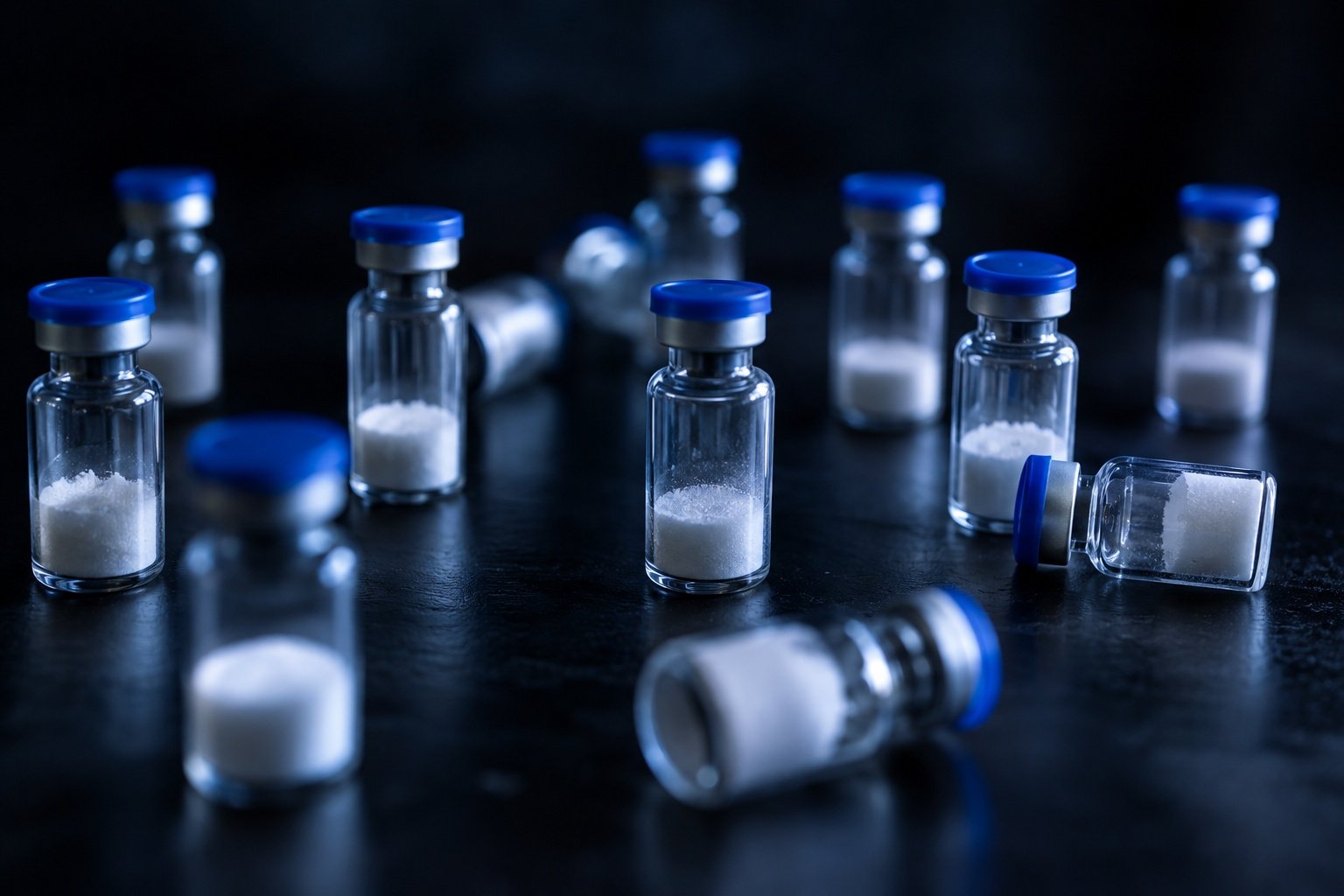
So we checked. Over the past two years the Institute has purchased and independently tested 23 BPC-157 samples from 12 different sellers, using anonymous retail orders shipped to unaffiliated addresses. Every sample went to a contract laboratory under chain-of-custody documentation for reversed-phase HPLC purity analysis and mass-spectrometry identity confirmation, with quantitative content analysis where the product carried a milligram claim.
The headline finding is that most BPC-157 on the market is roughly what it says it is, and a meaningful minority is not. 19 of 23 samples, 83%, met their label claims on both purity and content. That leaves 4 that did not: 2 with measurable discrepancies against the label and 2 that failed verification outright.
The spread is the part worth sitting with. Measured purity across the cohort ran from 61% to 98.9%, against a claim that is almost universally stated as "≥98%" or "99%+". Two vials of nominally identical product, bought in the same month from two companies with similar-looking websites, can differ by 37.9 percentage points of actual compound. Nothing on either label would tell a buyer which one they had.
Company identity turns out to predict this better than price does. Apex Peptides averaged 97.4% across 3 samples with no failures or discrepancies. At the other end, Cascade Research Group averaged 74.2%, with a single-sample low of 61%. Both sell the same compound at broadly comparable prices.
We want to be precise about what this does and does not establish. It does not tell you that BPC-157 works, the human evidence for that remains thin, and nothing in a purity assay speaks to efficacy. It tells you that if you have decided to obtain it, the seller you choose materially changes what ends up in the vial, and that the difference is measurable, consistent, and invisible from the product page.
Every specimen in this investigation is published in full in our testing database, including the chromatograms, the laboratory that ran each assay, the lot number and the purchase date. Companies were notified before publication and given our standard dispute window. Where a sample failed, we purchased and tested a second sample from a separate lot at a different laboratory before publishing anything.